


Architecture That Follows the Heart
Updated: Mar 12
Anna Heringer Says Sustainability Is Synonymous with Beauty

Anna Heringer, architect, author, teacher, and winner of multiple awards, has discovered a secret to beautiful and sustainable building: Form follows love.
As a young adult, the German-born Heringer spent a year in Bangladesh, where she was involved with a nongovernmental organization, Dipshikha. It was there that she learned about sustainable development, traditional building techniques, and local materials.
Since then, Heringer has used “low-tech, high-impact solutions” on three key projects in a village in the Dinajpur district of Bangladesh. The first was the Modern Education and Training Institute (METI) Handmade School, which was built in 2005 and won the Aga Khan Award for Architecture in 2007. Next was the DESI Vocational School, constructed in 2008, and then the Anandaloy Building, a center for people with disabilities that is combined with a textile studio, which was completed in 2020.
A key feature of these projects was the use of clay in a technique known as cob (which combines local subsoil, with straw and water). When used along with bamboo, local craftspeople can create durable, innovative buildings.
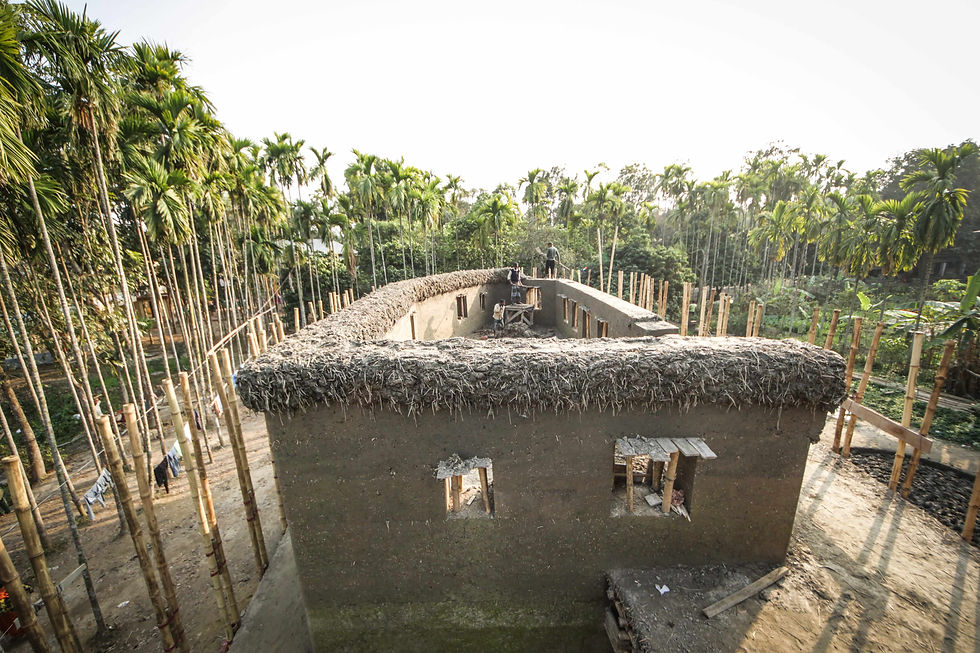

Some of Heringer’s other projects include bamboo hostels in China; an Ayurveda center in Germany, which is made of timber, earth, and willow; and the Don Bosco Earth Campus in Ghana, constructed of soil.
Love, Not Fear
Heringer’s approach is to improve lives by emphasizing love in architecture.
“I realized, especially working in Europe, that a lot of decisions are based on fear, liability,” she tells The Earth & I. “That led to a lot of thoughts—who wants to live in neighborhoods and buildings that are built out of the notion of fear? That results in an overuse of materials, because you want to be on the extra-safe side. So, you put in more steel, you put in more cement, and you take all sorts of paint and varnish to make it look perfect.
“The only thing that is stronger than fear is love,” she explains. “It's easy, and so if we start building out of love and respect towards others and towards our beautiful planet, sustainability happens in a completely natural way.”
“If we start building out of love and respect toward others and toward our beautiful planet, sustainability happens in a completely natural way.”
This approach means looking at what resources are present and recognizing their potential rather than relying on imported goods and materials. It also means taking local skills into account and shaping architecture so imperfections are accepted and improvisation can take place.
Joyful Living and Inclusivity
Tied to the idea of love is joyful living. Heringer comments: “I think the biggest joy is when […] people came together and helped build each other’s homes.”
She adds: “Our projects, quite basically, are involving other people, locals, and, using a very inclusive material like earth, you could have kids help in building the school in Bangladesh […] and even people with disabilities. When you have a material where you need sophisticated tools that can harm you, it's not really inclusive. If you have materials that are toxic, it's not inclusive. So, through working with earth, we have this inclusivity, and we can bring back the joy and the community bonding effect.”
Sustainability
Sustainability is a synonym for beauty, claims Heringer. “Beauty,” she says, “is really when something is deeply in harmony, not just on a formal level, but also on a social level, and in harmony with nature.”
The structure should also be replicable and consist of the same materials that local people use at home.
To ensure the structures stand the test of time, Heringer’s team creates strong foundations and roofs, so the earth is protected from the elements.

Her flagship project, the two-story METI school, demonstrates this principle. It offers ground-floor classrooms with “thick earth walls” that open to a system of “caves” and an upper floor consisting of bamboo walls with a vibrant sari-canopied ceiling.
The traditional materials are reinforced by foundations built from brick masonry and finished with a cement plaster, a damp-proof course made of polyethylene film (available locally), and a corrugated iron roof, supported by bamboo rafters, providing optimal runoff.

Every project is evaluated to determine its environmental impact, and efforts are made to enhance the local ecology.
Learning from the Material
Heringer describes how the METI project has influenced her. The caves, she says, arose out of the “material language,” while the “bending strength” of the bamboo gave the caves their final shape.
“You can trust in the material. And you know when you use beautiful materials, then there can also be some imperfection, which is beautiful.”
“You can trust in the material. And you know when you use beautiful materials, then there can also be some imperfection, which is beautiful. […] Earth is an element. It's not just a building material, and you feel it. So, I know, as an architect, I can lean a bit back and don't have to do such a bold thing, because I know that the material itself has already a beautiful voice,” she says.


One of Heringer’s current projects is the Don Bosco Earth Campus in Tatale, Ghana. The school aims to prevent an exodus from the countryside to cities by providing training in sustainable construction techniques, agriculture, and electrical work. It will also offer student and teacher accommodations, a community hall, and library. Heringer is taken aback by the beauty of the orange soil from which it is being built.
“Every moment in a day, when the light is changing, it looks completely different. And sometimes you have the feeling, even when the sun goes down a bit, it starts glowing on its own,” Heringer says. “It's an incredible effect, but you feel like real nature is a cooperator here. It's not you creating something out of nature. No, there is a voice there too, and you are just a part of it. And it is also a humbling experience to say, ‘OK you don't have to do the whole drama on your own.’”

“Architecture has always been a community. […] No one can build the house alone. It's always a team effort.”
The women participating in the build were using the atakpame technique, which caught Heringer by surprise. It involves shaping the earth with their hands rather than tools, resulting in curved rather than straight windows. Heringer believes this will lead to greater authenticity, which can be enhanced and exaggerated. “These,” she says, “are the things that are happening on the site out of the process when you’re working together.”
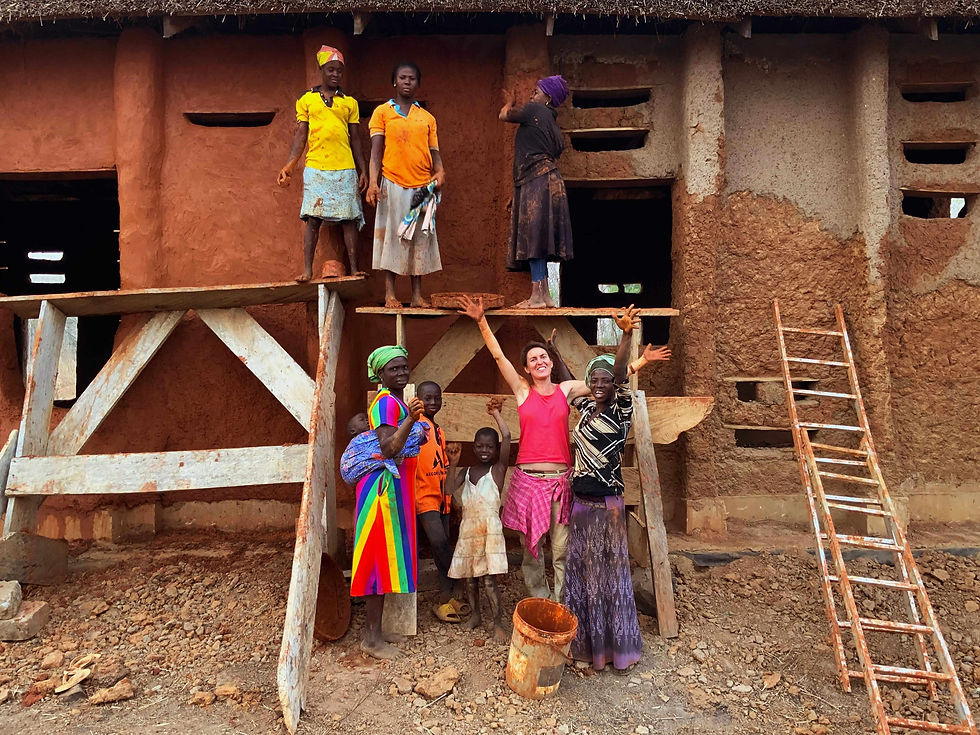

The processes of building are just as important as the outcome, Heringer says.
“There is so much social power in those processes that we completely neglect, and we see how dramatically we drift apart as a society. […] Architecture has always been a community. […] No one can build the house alone. It's always a team effort.”
Clay Storming
At the University of Lichtenstein, where Heringer teaches, she tries to communicate this message to her students. Together with Martin Rauch, she has developed “clay storming,” which involves designing directly onto a model. The approach emphasizes intuition rather than analytical planning and can be used while working alone, in a team, or with clients.
She has also drawn up the Laufen Manifesto, a set of guidelines for creating a “humane” design culture.
“It's not a question of money, in the end,” Heringer concludes. “It's a question of care and love and respect for the material.”
*Yasmin Prabhudas is a freelance journalist working mainly for nonprofit organizations, labor unions, the education sector, and government agencies.


The bathroom I remember most was not the largest one; it was the one where every decision about light, storage, surfaces, and movement made the small room feel calm and intentional. That changed how I think about renovation companies because design is only valuable when the finished space works for the person using it every morning. I pay attention to measurements, material choices, installation timing, cleanup, communication, and whether the completed shower or bath matches the plan discussed at the beginning. For homeowner experiences that cover that full process, I check https://bath-planet.pissedconsumer.com/review.html instead of judging a renovation from before-and-after photos alone. Architecture can feel personal even in one small room. The useful review is the one that explains how the space…
I have been testing different tools lately because manual sketching takes too much time. Most software requires long tutorials but some web platforms generate variations instantly. I found an option where you can use ai room design free without login https://paintit.ai/tools/ai-room-design/ to test how different style presets look in a specific space. It applies materials and organizes visual ideas on one canvas pretty fast. The results are not perfect for technical construction blueprints but they help to visualize a general concept before making final decisions. It works well if you want to skip complex software or avoid spending hours on manual mockups when you just need to see a vague thought transformed into a clear style.