


A Looming Nuclear Reversal
Why Countries from Europe to the Far East Are Rethinking the Future of Clean Energy
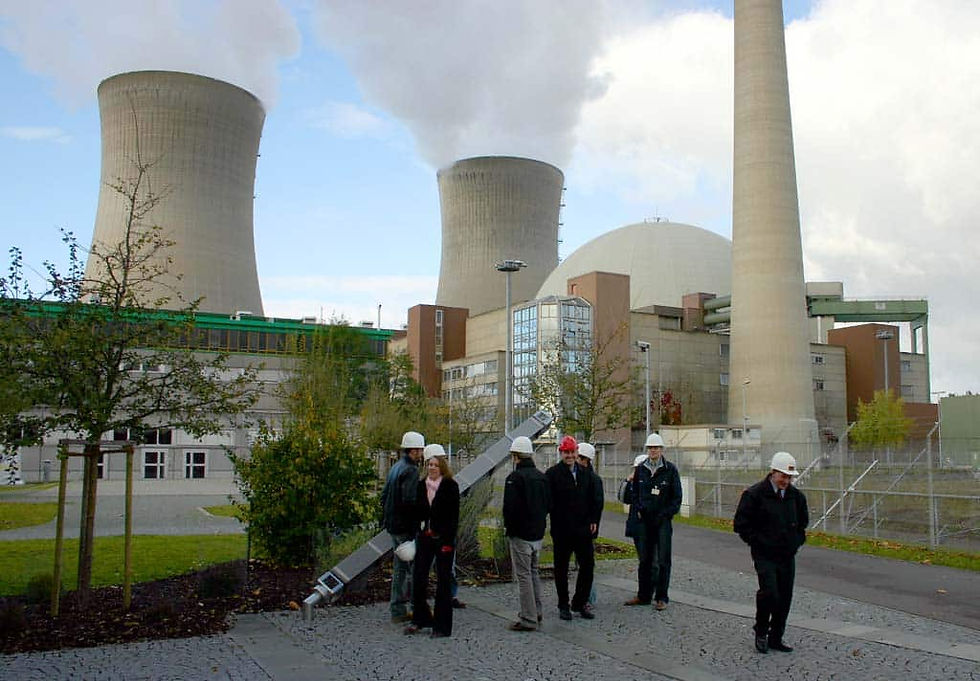
For decades, nuclear power seemed to have a time problem.
A reactor took many years to build and sometimes decades to shut down, but its waste stayed radioactive for thousands of years. After the disasters of Chernobyl in 1986 and Fukushima in 2011, many governments decided the future would arrive before the nuclear industry could fix its problems.
Now, several things are happening at the same time that are making governments rethink their policies on nuclear power.
Electricity demand is growing faster than expected. Data centers running artificial intelligence need power around the clock. Countries are trying to move away from fossil fuels to meet climate goals. And the wars in Ukraine and the Middle East have shown how depending on imported energy can quickly become a serious problem.
Nuclear energy, which many countries were ready to quit altogether, is back in the conversation.
Nuclear power accounts for just under 10% of global electricity generation and remains the second-largest source of low-emissions electricity, behind hydropower.
The International Energy Agency says that more than 40 countries currently support some form of nuclear expansion. Nuclear power accounts for just under 10% of global electricity generation and remains the second-largest source of low-emissions electricity, behind hydropower.
That does not mean the old problems are gone. Cost, safety, radioactive waste, and long construction times are still real. But governments are weighing them differently now.
Why So Many Countries Wanted Out
For much of the late 20th century, phasing out nuclear power felt like the responsible choice.
The Chernobyl disaster demonstrated that a nuclear accident could have consequences far beyond the site where it occurred. Decades later, Fukushima showed that even a technologically advanced country was not immune to catastrophe. At the same time, nuclear projects became associated with high costs and delays, while solar and wind energy gained ground in power systems.

Germany made its nuclear exit part of its Energiewende, its energy transition. Belgium passed a law in 2003 to close its reactors step by step. Italy went first: After a 1987 referendum, it began phasing out nuclear, and by 1990 it had stopped producing it completely.
The plan seemed simple. Close the old plants, build more renewables, and run a low-carbon grid without nuclear. But it turned out to be harder than that.
War in Ukraine
When Russia invaded Ukraine in February 2022, it exposed something that years of energy planning had not fully prepared for: A country can be making progress on clean energy and still be deeply vulnerable if it depends on imported fuel.
Belgium is one of the clearest examples. During the energy crisis that followed the invasion, the Belgian government extended the operation of two reactors—Doel 4 and Tihange 3—by 10 years. In May 2025, the parliament went further and repealed the 2003 phase-out law, removing the ban on new nuclear capacity.
This does not mean Belgium is giving up on renewables. The country now sees nuclear and renewables as working together, because it wants to cut carbon and also keep its power supply secure.
Keeping Old Plants Running
Spain is dealing with a different version of the same problem.
The country still plans to phase out nuclear power, but in August 2026 it approved an extension of the Almaraz plant, its oldest reactor, until June 2030. When announcing the decision, the government pointed directly to the conflict in the Middle East and its effects on gas prices and market uncertainty as the reason. For a country without significant domestic fossil fuel resources, that kind of instability makes a strong case for energy sources that do not depend on imports.
At the same time, Spain said renewables and storage are still its long-term answer for reducing dependence on imported fuels. As Mycle Schneider, a German nuclear energy consultant and lead author of The World Nuclear Industry Status Report, told The Earth & I in an email interview, “Combined solar-plus-battery systems can now be deployed within months at competitive cost, providing a long-term [energy] solution. Implementation happens at breathtaking speed, as more than three-quarters of grid-connected battery capacity in the world has been added since 2022.”

Almaraz shows why this debate is not simply nuclear versus renewables. Closing a reactor means losing a source of electricity that works regardless of weather conditions. Replacing it without increasing emissions requires not just solar panels and wind turbines, but also storage, updated grids, and backup power for when the sun is not shining and the wind is not blowing.
Choosing between [nuclear and renewables] based only on price per unit of electricity misses a big part of the picture.
Solar and wind have a clear advantage in cost. New installations are now significantly cheaper than building new large nuclear plants. But nuclear produces electricity continuously and with low emissions. Choosing between these sources based only on price per unit of electricity misses a big part of the picture.
The Demand Nobody Fully Predicted
Something else changed the conversation in ways that few energy forecasts from 10 years ago anticipated: the rise of artificial intelligence.
Data centers need large, steady amounts of electricity, and they need it all day and all night. The IEA points to this, along with the electrification of transportation and industry, as one of the main reasons governments are looking at nuclear again.
Small modular reactors (SMRs)—which produce up to 300 megawatts of electricity (MWe) per unit—have become a big part of these discussions. Unlike the large plants built in previous decades, which produce 1,000–1,600 MWe per unit, SMRs are designed to be smaller, more standardized, and potentially faster to build, with modular parts being manufactured off site and then shipped to the building site.
The idea is that smaller nuclear units could reduce the financial risks that have made large projects so difficult in recent years. The US has 28 siting announcements for SMRs, more than Canada (9), the UK (7), and Russia (5) combined.
There are also designs being developed for microreactors, which are designed to generate 50 MWe to less than 20 MWe. The IEA estimates the first commercial SMR projects could be running by around 2030, but that still needs to be proven in practice.
Two Countries Reconsidering Nuclear
Taiwan shut down its last reactor in May 2025. Less than a year later, in March 2026, national utility Taipower submitted a plan to regulators exploring whether its third nuclear plant could restart. Even if approved, the company would still need safety checks, inspections, and a new operating license before producing any electricity.
The pressure is significant for an island at the center of global semiconductor production, an industry that uses enormous amounts of power and is growing alongside AI.
Italy is taking a different path. Nearly 40 years after the public vote that ended its nuclear program, Italy's Senate gave final approval on September 23, 2026, to legislation paving the way for a return to nuclear power, passing 81 votes in favor, 51 against. The bill gives the government 12 months to set up rules covering reactor licensing, safety standards, and waste management. Energy Minister Gilberto Pichetto Fratin called it a historic step, saying nuclear energy “when integrated with renewables, is a winning technology.”
Countries That Never Left
While some governments are still debating whether to reverse course, France, the United States, China, and Russia never really stopped believing in nuclear.
France gets about 70% of its electricity from nuclear power, the highest compared to any country in the world. That was a choice made after the 1973 oil crisis, and France never looked back. Now it is going further, with plans to build six new reactors and possibly eight more.

The United States never stopped considering nuclear power either and today gets 18% of its electricity from nuclear generation. That endorsement is growing stronger, with SMRs being developed to power data centers and the US Army committing $2.2 billion to put microreactors on military bases. The investment is clearly there, and there is no hesitation. And with the US being so much like the world’s economic engine, commitments like these send signals to other countries that nuclear is a valid road to follow.
The People’s Republic of China and Russia, for their part, have fully embraced nuclear power generation and are expanding their global footprint. With 34 nuclear reactors in operation, Russia produces about 19% of its electricity from nuclear and is building five new reactors domestically, with 23 more in the planning stage. While China generates only some 5% of its electricity from nuclear, it has 60 operational reactors and 37 under construction (the highest globally) with scores more planned or proposed. Both countries are aggressively building nuclear reactors in foreign countries and promoting their respective reactor technologies, while the US and France are lagging behind.
The Hard Part
But enthusiasm does not mean much when the big challenge is building a reactor on time and on budget.
Large reactors are still expensive and slow to build. Recent projects in wealthy countries have gone significantly over budget and behind schedule.
Large reactors are still expensive and slow to build. Recent projects in wealthy countries have gone significantly over budget and behind schedule. Financing remains difficult; big interest payments must be made to lenders over the many years of construction while no electricity is being produced for profit. The industry needs to rebuild the workforce and supply chains that were allowed to shrink during the phase-out years. And no country has fully solved the question of what to do with radioactive waste over the long term.
SMRs might ease some of this, but they still have to show they can be faster and cheaper.
How the public feels about it is another issue, and no technology can fix that alone. Germany is a good example. It shut down its last three reactors in April 2023 but has been consumed since then by a fierce debate over reinstating nuclear power. However, talking about such a reinstatement is not the same as changing course. In May 2026, a committee of the Bundestag, the German parliament, rejected a proposal to cancel the exit and restart the reactors that had closed.
So nuclear power is gaining ground politically in many countries, but they are not all reaching the same answer.
Where This Leaves Us
The most important shift may not be in the reactors themselves but in how governments are now thinking about the question.
They need to cut carbon while moving cars and factories to electricity. They need to power a growing digital world. And they are doing it at a time when energy dependence has become a national security worry.
None of that fixes nuclear power's history of problems.
It is also too early to say whether this will make nuclear a lasting part of power grids or just a bridge while renewables, storage, and grids get better. Belgium, Spain, Taiwan, Italy, and Germany are all going in different directions, so the answer is still being worked out.
All that we can say is that national attitudes toward nuclear energy today are in flux, and that many governments no longer see quitting nuclear power as the obvious choice. But with the US in the West and China and Russia in the East now putting political, economic, and technical muscle behind nuclear, the door may be opening wider for this form of clean though controversial utility-scale energy.
*Leniva Leon is a freelance author living in Prince George’s County, Maryland.


Comments