


Lighting Up Earth’s Far Corners
Community and Household Solar Is Electrifying Remote Communities in Underdeveloped Nations

Electricity is life-transformative. It can bring people and families from a literal “dark” age and open up for them an array of new possibilities in education, work, friendship, family, and health.
This is what the people of an increasing number of rural, remote communities in less-developed areas of the world are experiencing as various organizations bring solar technology to their doorstep. Two villages highlight this progress: Vila Limeira in the Amazonas state of Brazil and Kasakula, Malawi.
In a time of extraordinary technological progress, extreme poverty is still the norm in many parts of the globe. According to the International Energy Agency, 730 million people lacked access to electricity in 2024. This is 9% of the global population of 8.2 billion.
Shining a Light in Amazonia
One area that is benefiting tremendously from rural electrification efforts is the Amazon rainforest.
Eighty percent of the Amazon River’s 4,000 miles lies in Brazil, along with much of the Amazon rainforest and watershed. The country has a robust electrical system, but there are still hundreds of thousands of people in remote rainforest communities without access to electricity. According to Alessandra Mathyas, a conservation analyst at the World Wildlife Fund (WWF)-Brazil, the main reason for this is the distance involved in crossing forests and rivers with transmission infrastructure. It “would cause significant environmental damage and would provide little financial return” for the utilities that provide the infrastructure, she says.
[Brazil] has a robust electrical system, but there are still hundreds of thousands of people in remote rainforest communities without access to electricity.
Recognizing this, the Brazilian government in 2003 launched a program called Luz para Todos (Light for All). The program provided funding to expand electrical access into remote rural communities. It emphasized the expansion of networks, on-site photovoltaic (solar) systems, and minigrids powered by solar and biomass generation. More than 20 years later, the program is considered a success, with more than 20 million rural households now connected.
Mathyas notes that the government program has invested primarily in individual photovoltaic systems. She adds that while these systems provide some electricity to families and communities, she believes they are “insufficient to ensure a good standard of living or to stimulate productive activities.”
To help fill this gap, WWF has embraced minigrids to provide sustainable electricity to homes and communities that are typically located in clusters. Mathyas says, “They provide greater power for productive uses” and “continuous, reliable service to families.”
In 2021, WWF implemented a 32 kW microgrid powered by solar photovoltaic panels in Vila Limeira, a small, riverside community of 90 people in southern Amazonas state. The project was the result of careful planning, collaboration, and involvement from the community's residents.
First, Mathyas and the WWF conducted a survey of energy needed for homes and local agricultural production, which is the primary source of income for the community. The survey also included the local school, community center, and church. It pointed toward a photovoltaic minigrid—rather than individual-home solar panels—as the best solution for the community.
Residents helped with the installation by preparing the site for the new system. They constructed a storage space for the batteries and, with the help of the WWF, trained two individuals in system maintenance, including monitoring battery performance, consumption, and charging.
The minigrid has been a success. It allowed Vila Limeira to become the first 100% solar-powered community in the region.
The benefits of this transition have been tremendous. The minigrid allowed the community to wean itself off of generators powered by very expensive and dirty diesel fuel and provided electricity continuously rather than for short increments of only a few hours at a time. Small things, like a water fountain with cold running water in the school and a lighted kitchen at dinnertime, became realities. Residents no longer had to travel down to the river to wash clothes because now they could use appliances in their homes.
The grid has also helped the community economically. Residents have achieved great savings on their energy costs, and the increased efficiency in their agricultural production has boosted their access to markets and supported plans for expansion.
“This project can inspire Brazil and other countries in the Amazon to bring affordable energy to places that are still without electricity.”
“This project can inspire Brazil and other countries in the Amazon to bring affordable energy to places that are still without electricity,” said Mathyas.
Other organizations have adopted similar approaches in the region. According to Roxani Roushas with the United Nations Development Program’s Rome Centre for Climate Action and Energy Transition, “traditional grid expansion is often not technically, financially, or environmentally feasible” in remote rural communities. She adds that in these locations, “decentralized renewable energy solutions become essential.” These include minigrids, solar home systems, hybrid systems, and other stand-alone technologies.

One program that has successfully adopted this approach has been the Aylluq Q’anchaynin program in the Indigenous community of Alto Mishagua in Peru. Led by six college students at the Federal University for Latin American Integration (UNILA) in Foz do Iguaçu, Brazil, the program installed a complete solar energy system to power 40 households in the community.

Beyond bringing reliable access to electricity, … education, communications, emergency response, public services, and social programs have all improved.
The program has seen many benefits. Beyond bringing reliable access to electricity for 40 families, it has strengthened the community’s autonomy through self-sufficient energy generation. Education, communications, emergency response, public services, and social programs have all improved. Families also have cut down on fuel consumption and long trips via riverboat to cities for the things they need. As Roushas points out, “the impact goes far beyond energy.”
Sunshine in the Sub-Sahara
More than 5,000 miles and an ocean away, solar energy is also improving the lives of residents in another continent.
Sadly, poverty and lack of access to electricity are pervasive in sub-Saharan Africa. According to the World Bank, the region is home to nearly 60% of the world’s population living below the international poverty line.
Many of the countries in the region also rank among the world’s poorest. Malawi, for example, is considered the fourth-poorest country in the world, also according to the World Bank. Heavy reliance on agriculture and vulnerability to the extreme effects of climate change leave more than 70% of the nation’s population in poverty.
Here, too, organizations have stepped in to address the problem. Sustainable Energy for All (SEforAll) is an independent international organization created by former UN Secretary-General Ban Ki-moon to accelerate affordable, reliable, and sustainable energy. It emphasizes evidence-driven planning, policy support, and finance mobilization.
In Malawi, SEforAll helped launch the Integrated Energy Plan (IEP) in 2022. It is a unified planning framework that combines electrification expansion, clean cooking, and even vaccine distribution logistics on a single open-access platform.
Alexandros Korkovelos is a senior officer of energy planning for SEforAll. He notes that Malawi continues to face significant electricity access challenges, with only roughly one in six people estimated to have any form of electricity (grid or off-grid). “This means that millions of people, and a large share of public services in areas where these people live, still operate without reliable power,” he says.
Korkovelos explains that the lack of access to reliable supplies of electricity can be attributed to several factors. These include a dispersed rural population, the inability of families to afford electricity and the costs associated with it (e.g., connection cost, taxes, and appliances), a weakened and under-resourced power system, and challenges around aligning policies and coordination within the energy sector.
The IEP developed by SEforAll envisions a mix of technologies and strategies to achieve 100% access by 2030. These include grid densification (connecting more families who live within reach of existing grid infrastructure), grid expansion, minigrids, and—in the most remote areas—solar home systems.
The last of these strategies has been the focus of groups like SolarAid, an international charity dedicated to tackling poverty and the climate crisis by helping to bring clean, safe solar lighting to the most rural and inaccessible areas of the region. Its Light a Village program applies a unique model that has demonstrated a successful approach.
According to Brave Mhonie, general manager of SolarAid in Malawi, the program has succeeded by “taking away the access barrier.”
The [SolarAid] program provides “energy as a service,” selling electricity rather than hardware, and so has brought solar power access to remote rural communities at a price they can afford.
The program provides “energy as a service,” selling electricity rather than hardware, and so has brought solar power access to remote rural communities at a price they can afford. The program has innovated the concept of distributed solar power by providing each household and community building with their own solar systems. Ownership of the hardware remains with the utility provider, so customers pay only for the electricity they receive. This approach overcomes the prohibitive cost of buying a new solar system, which is a hurdle even in affluent societies.
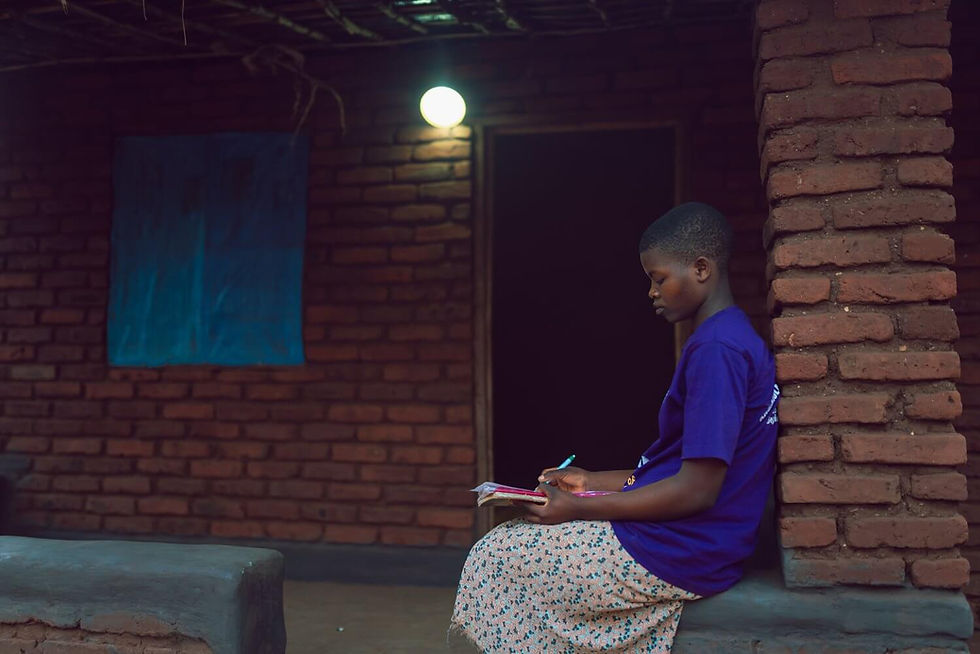
On the other hand, social conditions created a strong incentive to act. Fifty percent of the population in the SolarAid communities were women, but their participation in local schooling was very low. The lack of access to electricity created barriers for their participation.
Now, with near-universal access to electricity (99% of households), the results are tangible, says Mhonie. “Now young women do not have to travel at night to learn,” he says. “They can spend a longer time studying at home.”
The connections have also improved the economic well-being of the communities. According to Mhonie, “households have increased their productivity, and connected shops have increased their working hours.”
More than 9,000 customers have now been connected, plus 12 schools in the area and teachers’ homes. The program also recruited and trained 84 customer service representatives, technicians who can perform needed maintenance on the installed equipment.
A Better Life for All, Under the Sun
In many places around the world, government agencies, utilities, and nonprofit groups are teaming up to help poor, remote, and rural communities increase their access to electricity. They are taking their lessons and bringing them to other places of need.
The benefits of this reach beyond the communities themselves. According to Mhonie, it is a good thing to provide access to solar energy in these remote rural communities. “No one deserves to live in poverty,” he says. By bringing light to villages, he explains, SolarAid and other organizations’ efforts are “making life on Earth a better life.”
*Rick Laezman is a freelance writer in Los Angeles, California, US. He has a passion for energy efficiency and innovation. He has been covering renewable power and other related subjects for more than 10 years.


Really enjoyed this post. The information is detailed, clear, and presented in a way that keeps the reader interested. I particularly liked the practical aspects because they make the article more useful than a simple overview. Thanks for sharing your knowledge and experience. This was definitely worth taking the time to read. window replacement paradise valley village
This is a genuinely helpful and informative post. I appreciate how carefully you have explained the subject and included details that readers can actually use. The article is easy to understand and provides several useful ideas worth considering. Thank you for sharing such valuable information. I will certainly keep an eye on this blog for more interesting posts. pest control companies in san antonio texas
Thank you for sharing this amazing article. The writing style is engaging and keeps the reader interested from start to finish. I appreciate the effort you put into explaining the topic with clarity and useful insights. Posts like this are always valuable because they help readers understand things better without confusion. led red light therapy panel
I really enjoyed reading this blog post today. The information was presented in a very organized and reader-friendly way. It is clear that you spent time researching and creating quality content for your audience. I especially liked the practical advice you included throughout the article. Keep sharing more great posts like this. roaches
This is a very impressive and informative post. I appreciate how detailed and easy to follow the article is for readers of all levels. Your explanations are clear and make the topic much more understandable. It is always refreshing to come across blogs that provide real value and useful information. Thanks for sharing this. pest control brunswick