


Princeton’s ‘Farminary’ Levels the Praying Field
Updated: Sep 2
Could Princeton Theological Seminary’s Regenerative Ag Program Be the Future of Faith?

For generations, seminaries have prepared future clergy in classrooms, libraries, and sanctuaries. Today, at Princeton Theological Seminary’s Farminary, many of the most important lessons begin in compost piles, vegetable beds, chicken coops, and shared meals.
The New Jersey school’s Farminary—a blend of “farm” and “seminary”—is reimagining theological education by integrating regenerative agriculture with spiritual formation, ecological stewardship, and community life.
The Farminary also offers an unexpected model for healing. Students learn not only theology but also how healthy soil, seasonal rhythms, food justice, and honoring the Sabbath can reshape the way future faith leaders understand ministry. Rather than treating environmental stewardship as a niche concern, the program presents care for creation as central to spiritual life: Students from diverse backgrounds are invited to rediscover their relationship with the land—and with one another.

Reviving Faith and Earth
In an age marked by environmental anxiety, loneliness, and relentless productivity, could working the land become a pathway toward restoring both faith communities and the Earth?
Rev. Dr. Nathan Stucky, founder and director of the Farminary, didn’t always believe so. When he moved across country with his family to begin eight years of studying theology at the venerable Princeton Theological Seminary—the nation’s second-oldest seminary—he naturally assumed he would be abandoning his life of wrestling with soil for one of wrestling with theological questions.
“When I left farming in 2007 to move to the seminary to be a student, it was simply beyond my own theological or vocational imagination that [farming and theology] could go together,” he told The Earth and I via a Zoom call.
“When I left farming in 2007 to move to the seminary to be a student, it was simply beyond my own theological or vocational imagination that [farming and theology] could go together.”

Stucky grew up on a farm in Kansas and worked in youth ministry before becoming a farmer himself. Those years were where his love of the land, farming, and his Christian faith all took root.
As he studied theology, the connections between the natural world and the word of God became crystal clear to him. It was from these initial thoughts that the idea of the Farminary began to grow.
As Stucky’s theological studies were concluding, he approached the president of the seminary about his idea for a Farminary, having already been offered the use of a farm in Kentucky.
Although ideal in many ways, the farm in Kentucky was a 10-hour drive from Princeton. He then learned that Princeton’s seminary had its own 21-acre farm that he could use to establish his unique way of teaching future faith leaders.
The Parable of the Sower

Having the land was one thing, but growing crops on land exhausted by its previous tenure as a turf farm was another. “We wanted to plant a garden, but there was no topsoil,” Stucky explained.
He cited a sermon he had preached on the Parable of the Sower, found in the Gospels of Matthew and Luke, to show the connection between the Farminary’s land and the farmer in the parable who plants seeds on four types of ground.
“I can no longer read it as a story of three failures and one success. I can only see it as one long story that encompasses countless generations, endless cycles of life, death, and new life that in time can bring about a rich harvest even from the places and spaces that today seem most lifeless,” Stucky said.
“I can only see [the Parable of the Sower] as one long story that encompasses countless generations, endless cycles of life, death, and new life that in time can bring about a rich harvest even from the places and spaces that today seem most lifeless.”
The physical land of the Princeton farm “bears the wounds” of previous stewards, he said. “Too many of the norms of these relationships in our world are built on the same assumptions of extraction, exhaustion and exploitation.”
 |  |
Fresh, healthy growth shows that the former sod farm’s days of extraction, exhaustion, and exploitation are over. Images courtesy of Princeton Theological Seminary | |
These lessons from the land suggest that the Farminary can benefit everyone who works with it.
Growing Faith Leaders, Too
Over the life of the Farminary, as director of the project, Stucky said his own relationship with the word of God has altered radically: “I [now] read Christian scriptures completely differently from the way I did 12 years ago. Simply because when you read the Bible at the farm, or in the forest or with the stream, all of a sudden you recognize these are all characters in the story.”
This shifting perception about the natural world helped create the Farminary’s purpose: “The mission of the Farminary is ultimately about shaping this different kind of faith and faith leader that recognizes much of what has gone wrong in the world [is] because humans have placed themselves at the top of some kind of hierarchy. Now, we are learning to reposition ourselves.”
And that repositioning reframes what happens on the Farminary. The land grows tomatoes, squash, beans, and chickens, but it also impacts the people. “We hope to be growing on the farm a different kind of leader. I put myself in that pool of leaders needing to be reformed or shaped anew,” Stucky said.
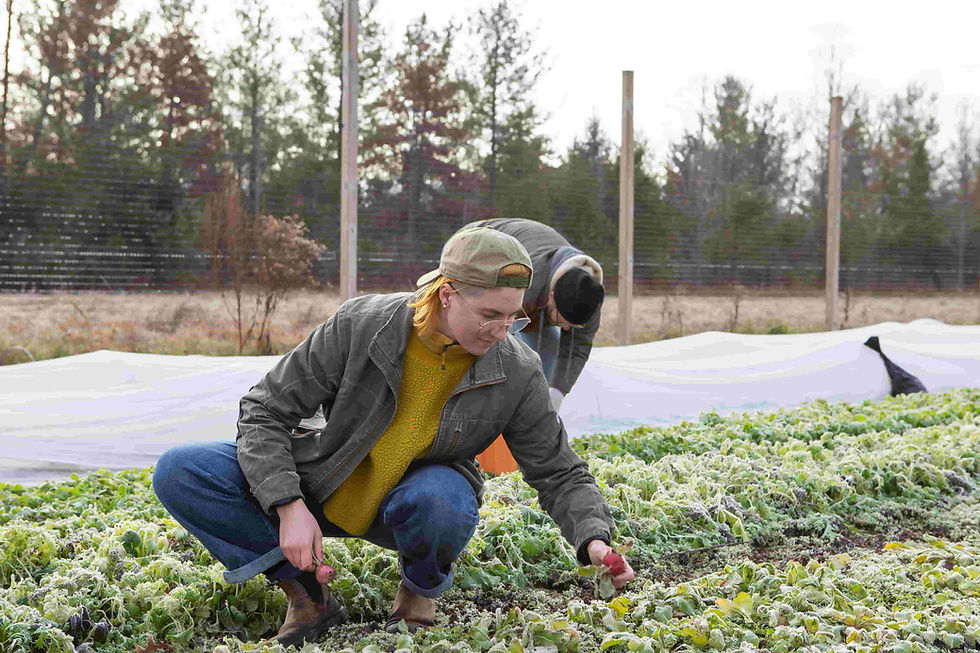
“Our teachers are the Spirit who is ever recreating the trees and the insects and the soil and the waters,” he added.
Learning from nature is emphasized on their very first day for students pursuing the Master of Arts in Theology and Ecology. They are told to find a tree to befriend, then spend time with it, observing it closely: “The exercise is how we reframe ourselves relative to these nonhuman creatures.”
Learning from nature is emphasized on their very first day for students of the Master of Arts in Theology and Ecology. They are told to find a tree to befriend, then spend time with it, observing it closely.

Not all activities are so benign. One of Stucky’s colleagues teaches a course on the theology of food ethics, which requires spending time with the farm’s chickens. When it is time for the birds to be slaughtered, the students must be on the farm as a minimum requirement and can be as closely involved in the butchering as they can handle. Finally, the class eats a communally prepared meal with those chickens as the main course.
“We can sit in a library or a traditional classroom and read those texts about the theology and ethics of food, where you can learn good things,” Stucky said. “But the power of the farm makes the subject matter self-evident; it is not just about ideas in the ether but about flesh-and-blood reality. We are talking about the actual lives of creatures.”
As would be expected from graduates from such a unique seminary, their destinations are not necessarily within ministry. Many go on to work for nonprofit organizations, including those that tackle food security or food justice. One graduate returned to his previous role as a landscape architect with the new understanding that all decisions are rooted in values of some kind, even if not necessarily religious. Another graduate became a minister to a Presbyterian Church that had lost its church building and now worships almost exclusively outdoors.
Honoring the Sabbath
As much as the Farminary is about working towards a better world, it is also about rest.
As Stucky, author of Wrestling with Rest: Inviting Youth to Discover the Gift of Sabbath, explained: “Life is a pressure cooker for young people; never stop achieving, never stop producing, never stop consuming. Sabbath is the release from that. The exhaustion of people and of the land [are] two sides of the same coin; exhaustion is not God’s desire for creation.”

To make a lasting difference, the power of the Farminary cannot be limited to 21 acres of farmland in New Jersey, and Stucky is enthusiastic about creating future relationships outside its boundaries.
“I think the most exciting work in the next 10 years will be to get multidiscipline, multi-institutional people together with their hands in the soil, hands in the compost pile, thinking about what’s possible and how to reimagine the world.”
*Gordon Cairns is a freelance journalist and teacher of English at the Forest Schools, based in Scotland.


A high score can give web games an extra layer of motivation when there is always another record to beat.
동료가 추천해줘서 Arena King을 해봤는데, 전략 짜는 게 은근 머리를 쓰게 돼서 퇴근 후에 몇 판씩 하게 됩니다.
I enjoyed reading this perspective on how farming can become a space for reflection, connection, and meaningful community experiences. It’s interesting how thoughtfully designed environments can influence the way people engage with a place. The same principle applies to healthcare websites, where thoughtful gastroenterology website design orange county can make it easier for patients to find information, understand services, and take the next step toward care. A well-structured digital experience can be just as important as the physical environment in building trust and connection.
Un compañero de trabajo me habló de Arena King y los juegos de estrategia que tienen son bastante entretenidos. Los de construcción de reinos te pueden absorber un buen rato. Todo funciona directamente en el navegador sin tener que descargar nada.