


Racing Waters
The Dynamics and Dangers of Rapid Flooding

Flash floods are one of the world’s most treacherous weather events, as they occur with little warning and can cause severe damage and loss of life.
For many Americans, the 2025 July 4th holiday weekend turned into tragedy when a flash flood hit Camp Mystic next to the Guadalupe River in Kerr County, Texas. Some 137 people died, including 27 young girls and staff who were swept away in the dead of night. This was the 10th-most-devastating flash flood in US history, according to Yale Climate Connections.
In the aftermath, questions arose about unseen flash-flood warnings, a delay in evacuation by the camp leaders, new cabins built in the floodplain, plus the deadly combination of extreme weather and the region's vulnerability to rapid flooding.
Geography Matters
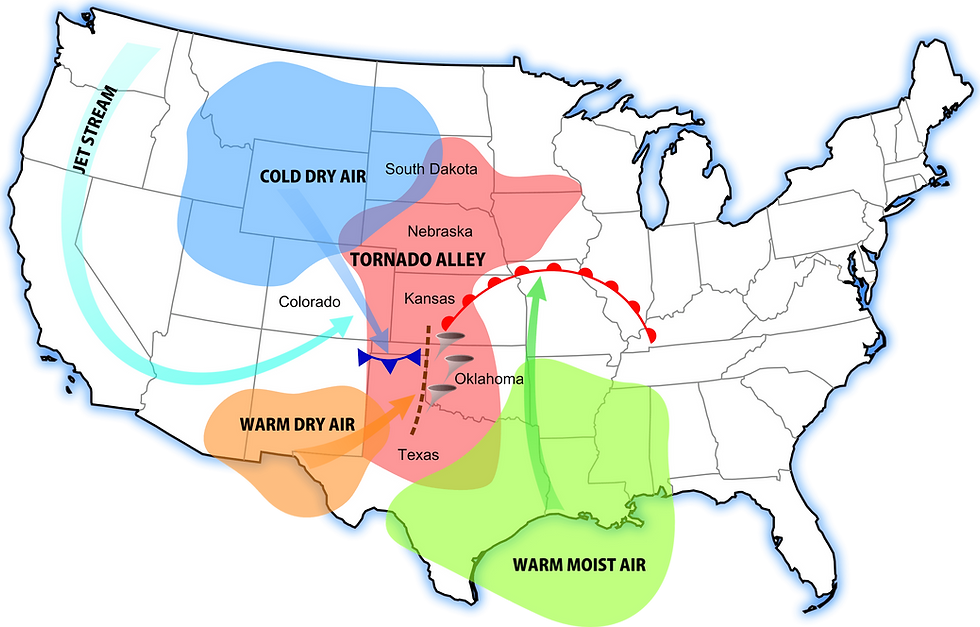
In the US, different regions are vulnerable to flash floods for unique reasons.
For example, the flat landscape of the states that make up Tornado Alley—Texas, Louisiana, Oklahoma, Kansas, South Dakota, Iowa, and Nebraska—allows storm systems to build up quickly and then remain over the same area, causing excessive rainfall and flash flooding. The rivers and streams have less capacity to handle sudden surges of water, and this leads to overflows and flooding. Oklahoma is one of the most at-risk states, receiving over 60 flash flood warnings every year.
Surprisingly, the dry Southwest is also at risk of flash flooding. Desert soil doesn’t absorb water easily, which is a problem during the monsoon season from mid-June through September. When moisture-laden air from the Gulf of America collides with the hot desert environment, it can cause sudden, concentrated downpours of rainwater. The geographic features of Arizona and New Mexico add to the risk, as steep canyons and arroyos (dry riverbeds) can quickly turn into raging torrents.
Urban development … creates large sections of impervious surfaces (such as concrete) that stop water from soaking into the ground.
In other parts of the US, human intervention has increased the risk of floods. Urban development in cities like New York and Philadelphia creates large sections of impervious surfaces (such as concrete) that stop water from soaking into the ground. During a storm, water overwhelms drainage systems, leading to localized flooding. In fact, New York’s mayor declared a local state of emergency due to heavy rain and flash flooding at the end of July 2025.
Slow-moving storms were only one factor in the Kerr County, Texas, disaster. Rainfall that was described as “extraordinary,” falling at up to 4 inches an hour, was supplemented by other sources of moisture. Tropical moisture from the Gulf, monsoonal moisture from the eastern Pacific, and remnant moisture from Tropical Storm Barry—which had made landfall on the east coast of Mexico just a few days earlier—all added up to create the “perfect” storm.
"Those are sort of the worst-case ingredients, from a meteorological standpoint,” Marshall Shepherd, director of the Atmospheric Sciences Program at the University of Georgia and former president of the American Meteorological Society, told ABC News.

The landscape and soil composition of Texas Hill Country, where the Guadalupe River flows, made the situation worse.
Texas has the unenviable record of leading the nation in flood deaths, and this part of the state is known as Flash Flood Alley. In the 60 years between 1959 and 2019, 1,069 people died due to flooding; this is over 1.5 times the 693 deaths in flood-prone Louisiana during the same period. This is because the steep hills in Texas make the water flow downhill quickly. As the area is semi-arid, with soils that don’t soak up much water, it causes the shallow creeks to fill with water quickly. When those creeks join a river, they create a surge of water that can destroy everything in its way: homes, cars, and, most devastatingly, humans.
As the area is semi-arid with soils that don’t soak up much water, it causes the shallow creeks to fill with water quickly. When those creeks join a river, they create a surge of water that can destroy everything in its way: homes, cars, and, most devastatingly, humans.
In the aftermath of the July 4th weekend disaster, many people have questioned what role a local flood warning system would have played to save lives. Forecasters were aware a massive flood was likely a few hours earlier, but the information wasn’t fully passed on to those at risk, giving them little to no chance to escape. In an area known for flash flooding, it may seem incredible Kerr County rejected—on the basis of cost—the chance to install outdoor warning sirens at a time when neighboring counties decided to do so. It is believed such a system would have saved lives.
On July 9, Texas Governor Greg Abbott announced a special legislative session that included topics like flood warning systems, flood emergency communications, and natural disaster preparation and recovery. A day later, Lieutenant Governor Dan Patrick and House Speaker Dustin Burrows created the Select Committees on Disaster Preparedness and Flooding, with the first hearing on July 23 and another on July 31.
“Now the work begins,” said Texas State Senator Charles Perry at the end of the session. “Let’s get our bills drafted and try to get them over the finish line in the next two weeks.”
Flooding and Climate Change

Sadly, extreme weather events are likely to get worse due to climate change. As the world heats up, the amount of water in the atmosphere increases, leading to a larger number of extreme rain showers and therefore more flooding. According to the Clausius–Clapeyron relationship, for every 1°C (1.8°F) rise in air temperature, water evaporation can increase up to 7% given how warmer air holds more moisture. But it is not only climate change increasing the danger; people are also putting themselves at greater risk based on where they choose to live.
It is not only climate change increasing the danger; people are also putting themselves at greater risk based on where they choose to live.
A study led by Jun Rentschler and published in Nature in 2023 reveals that over the last 40 years, human settlements around the world keep expanding into places that once would have been avoided due to flooding. These new settlements aren’t only villages; many megacities have been built on flood zones, potentially putting millions of people at risk of tragedy. A separate 2023 study in the journal Sustainability maps megacity expansion with correlation to urban flood risk.
In some parts of the world, cities are more likely to be built in dangerous flood zones than in safer parts of the country.
Research on Flood Response
Yet the risk might be worth it if there is a better understanding about flash floods. A growing body of research is focusing on the dynamics of these events with the aim of developing better prediction models and mitigation strategies.
A scientific paper published in 2022, for instance, looked at almost 30,000 other studies and found that while flooding will always be an unavoidable risk, it is also manageable. Floods can be minimized or made to change course through engineering and non-engineering measures.
As the risk and frequency of flooding increases, how people respond to them has changed. In the past, governments would try and control flooding through building projects, but as these systems didn’t stop the deluges destroying lives and livelihoods, they switched to trying to manage them, either through structural work such as weirs, dams, and seawalls, or keeping people away from flooding areas.
Traditional flood management measures tend to protect, reduce, or eliminate impacts and actions before an event. Now modeling techniques using probability and statistics have been found to be successful in predicting when flash flooding could occur. A 2024 study on an urban area in the sub-Himalayas had a very high accuracy level, and the authors expressed confidence that their results could help hydrologists, engineers, and water management administrators to control areas susceptible to flash floods.
In the meantime, ever-expanding cities near water bodies, such as in China, Japan, Indonesia, Mexico, and Argentina, face high risk of flooding, according to the 2023 study in Sustainability.
In the US, the Federal Emergency Management Agency notes that about 40% of flood insurance claims in the US come from low-to-moderate flood risk areas.
The agency recommends various measures to mitigate flood risks. These include elevating one’s property to above the ground, filling areas lower than the ground (such as basements), using sandbags to protect property, and installing water pumps to remove excess water.
*Gordon Cairns is a freelance journalist and teacher of English at the Forest Schools, based in Scotland.


One of my best scoring methods in Block Blast is creating combo streaks without breaking momentum. Consecutive line clears can increase points really fast.