


Running with the Rhythm of the Desert
Updated: Aug 25
How Paiute Singers and Runners Used Heart and Ancestral Wisdom to Survive
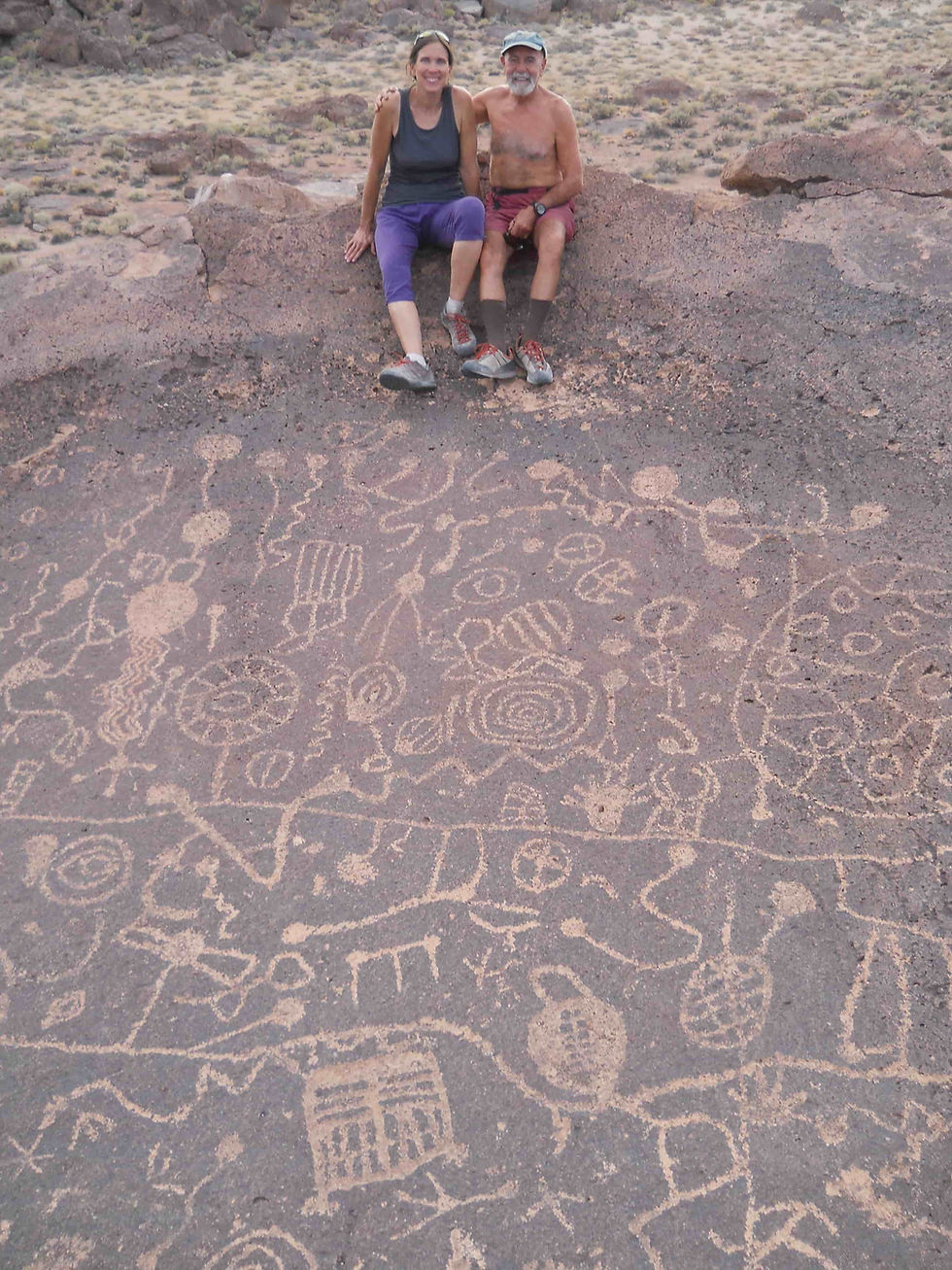
Long before modern maps, the Native peoples of the Mojave Desert in the southwestern US survived by singing their terrain—passing multiday songs down through the generations, songs that detailed every hidden spring and treacherous pass across hundreds of miles.
Centuries later, having been unexpectedly swept from the East Coast into the desert’s harsh embrace, I found myself on a sort of vision quest that paralleled ancient Paiute spirituality and Indigenous “runners’ guilds.” Through runs up to 100 miles, some of which were solo and trailless, and friendships with the local Paiute, I learned that the desert still speaks to those willing to listen to its rhythm, and that every person, if he or she tries, can come to feel intimacy with even an unforgiving environment.
I was born among the civilized cities on the East Coast and raised near its well-watered, mossy forests. Yet, at the age of 22, I moved to a drastically different setting, where Joshua trees and cholla cactus predominated. How did that ever happen?
A ‘Biblical’ Experience
At the age of 15, I had a “biblical moment” where I felt “called” to become a rock climber. This was not just a passing fancy. Rather, I developed a raging passion—at a time when climbing dangerous mountains was rarely done by women. My climbing partner, Jorge—a Jesuit priest from Bolivia—later exited the priesthood to marry me. We moved to Las Vegas, where he landed a job as an anthropology professor. I hated the environment there for two years. So hot. So dead. So harsh—or so I thought.

Back in the 1970s, there were no recreational trails in the deserts surrounding Las Vegas, so in order to stay fit for rock climbing, I jogged dry creek beds, ran along remnants of wagon train ruts, and often simply went cross-country through the sharp brush, despite shredding my legs. While trotting through the rocky canyons and basins, the desert beauty gradually began to penetrate my consciousness—especially at sunset—at that magic hour when light seems to emanate from the crimson rocks and the sky is an eruption of colors. I came to feel a deepest sense of awe on a daily basis.
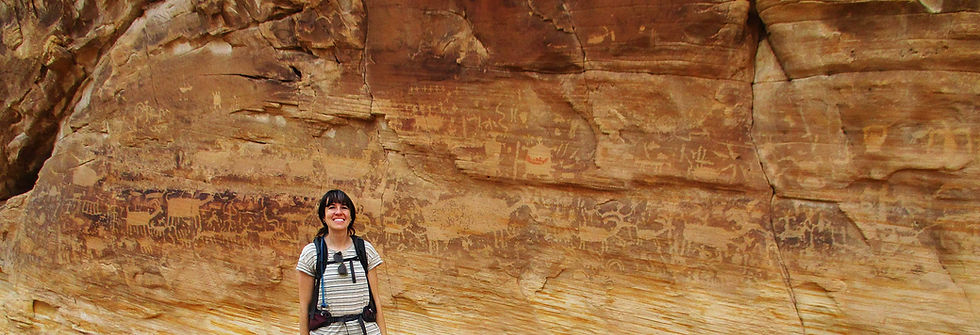
Cross-country foot travel brought me face to face with signs of those who’d been here before me: petroglyphs, archaic hunting blinds, smashed pottery and turquoise atop remote passes.
Cross-country foot travel brought me face to face with signs of those who’d been here before me: petroglyphs, archaic hunting blinds, smashed pottery and turquoise atop remote passes—ancient gifts from desert peoples to the gods—places that had been forgotten by modern man. Anasazi. Paiutes. I even stumbled upon sections of prehistoric footpaths, which I matched up with historical US Geological Survey maps from the late 1800s.
A Seminal Book
Because my husband was teaching anthropology at the University of Nevada at Las Vegas—and even studying and recording the Paiute language in 1975—I rubbed elbows with experts in the field of Mojave Desert ethnohistory. This led me to find a copy of Carobeth Laird’s seminal book The Chemehuevis, which I devoured. Laird, born in 1895, was a trained ethnohistorian and linguist. She ended up marrying her Chemehuevi/Paiute informant, George Laird, who was born in 1871 and had grown up within the Paiute culture just as it was starting to wither from the impacts of settlers’ westward movement across the American continent. She wrote several other books, and when she was 80, she published a well-received autobiography, Encounter with an Angry God.
Water is the most critical resource for desert hunter–gatherers, so when the wagon trains began traversing the Mojave, their stock animals drained and sullied the meager springs. Less water meant less game; less game meant less life. To survive, Native peoples intermixed with the newcomers, adopting their words but losing some of their ways and the richness of their own language. Carobeth, with her disciplined academic training, was able to capture—with her typewriter—the ways of life, the migration patterns, and the spiritual beliefs of her husband’s culture, traditions that had been practiced for over a thousand years.
Mojave Desert peoples stored their information in protracted songs—songs that literally took days to sing in their entirety.
I was particularly fascinated with her chapter on songs. Mojave Desert peoples stored their information in protracted songs—songs that literally took days to sing in their entirety—because they recorded migration routes and hunting strategies in great detail. These songs were passed from father to son, empowering the next generation to “know the land” even though they had never set foot in an unfamiliar mountain range or valley.

Two big categories were the "deer songs" and the "mountain sheep songs," which were sung presumably to assign different parcels of hunting terrain to young men in order to decrease rivalry and avert the possibility of war. The "salt songs" described important migration and salt-trading routes. Salt was necessary for survival in this land of relentless heat.
One day, I hiked to an ancient salt mine near Lake Mead, a huge body of water near Las Vegas, and actually saw an entire salt hill hollowed out with ancient tunnels. In a museum there, I saw the small bricks of salt that had been used for barter up until the 1800s.
The Way of the Shaman
One of the hurdles to becoming a shaman was going on a vision quest to “dream” a new version of his inherited song. This would typically involve spending three days in a cave—one that was considered to have supernatural power—and ingesting hallucinogenic plants like western jimson weed to trigger their dream.
Such dreaming was considered essential to impart the power to heal and invoke the positive forces of nature. Thus, the songs were not only a practical way of storing knowledge, but at times they spilled over from the physical plane into the spiritual.

As I continued jogging in the Mojave Desert—over many years—my runs got longer. The longer the miles, the more hypnotic my head space became. I began taking on highly challenging itineraries, like running across the Grand Canyon—and back—in 10.5 hours. I built up to 50 miles, then to 100 kilometers, then to 100 miles—all in mountainous settings—along with the added risk of mountain weather and dangerous terrain. This hypnotic head space developed into much more than a simple distraction—“it” seemed to “learn” how to help me through these challenges. An example is Mile 80 during the Hardrock 100-mile race, where for many miles I hallucinated invisible helpers running alongside me, which actually helped me continue.

The Paiute Runners’ Guilds
This is why Carobeth’s chapter on “The Runners” was particularly meaningful for me, because I myself had become an ultradistance desert runner, similar to the ancestral Paiutes. Why did they run? Running was necessary for their survival—for delivering messages among distant groups, for hunting over vast terrain, for scouting and trade.
Running was necessary for [the Paiutes’] survival—for delivering messages among distant groups, for hunting over vast terrain, for scouting and trade.
Carobeth described the runners as a spiritual “guild”—swift and fit—where those who had learned “the old way” could invoke magic for assistance. Her husband even swore that he knew a young runner who could teleport 100 miles instantly. Although most modern readers would quickly dismiss this as fantasy, my own supranatural experiences while ultrarunning give me a different stance: I feel curious—and speechless. And I couldn’t help but read the chapter several times.
My work as a registered nurse in the field of rheumatology brought me into contact with several patients from the Moapa Reservation near Las Vegas who came to be my friends. They educated me on a wide variety of issues, from the horrors of the Indian Schools, to the rituals at Paiute death ceremonies today, which demonstrate that modern Paiutes still value “humanity being one with the land.”
The Funeral Salt Song
I learned that a condensed form of the salt song is typically sung in Paiute at a funeral during the nighttime hours, starting at midnight, with the culmination at dawn. The “trail” of the deceased spirit starts in southwestern Utah and traces its way southward, through the Las Vegas Valley, looping its way eastward around Avi Kwa Ame of the Spirit Mountains, and across the Colorado River into Arizona. It then swings northward, following the western edges of the Hualapai Mountains, all the way to the South Rim of the Grand Canyon.
The song describes every pass, every wash, every valley—every little creature that greets you along the way.
The song describes every pass, every wash, every valley—every little creature that greets you along the way. At what landmarks do you take a turn leftward? Where is the best place to ford the river? Which petroglyphs will be your landmarks?
By the time the Grand Canyon blocks progress, the deceased has run over 150 miles, is tired and hungry, but yet must summon the monumental strength to bridge the enormous chasm. In taking this leap, he is borne upward into the sky, into the spiritual world from which he originated.
Modern life often takes us to cities—away from the earth. By enduring the Mojave hardpan, I found a connection to the land that used to be abundantly clear to those who came before me. I am grateful for learning this history, and I value the wisdom of my countless elders.
*Joanne Urioste is author of her recently published autobiography, Collages of Rock & Desire—Re-imagining Climbing in Red Rock, Risk in the Andes, & Running into Dreams, Wild Turkeys Press, 2025, available on Amazon. She has had worldwide influence in rock-climbing first ascents. In addition, she is a registered nurse and freelance author living in Las Vegas, Nevada.


Comments