


The Pain of Truly Loving a Forest
How America’s Original Woodland Ecosystems Can Be Restored, Plot by Plot
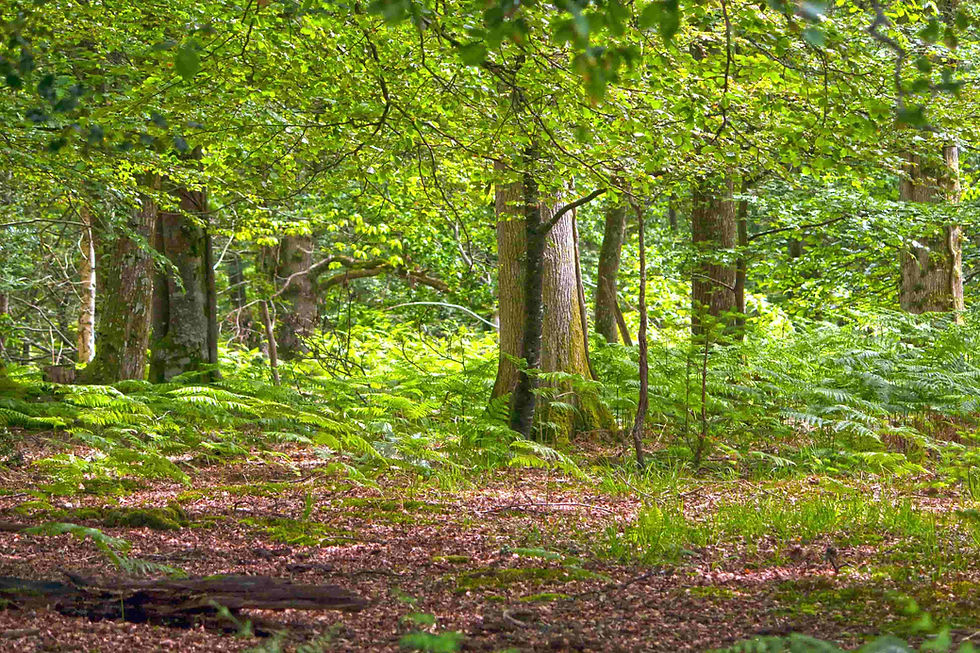
Conventional wisdom says the best way to protect a forest is to leave it alone. Forester Ethan Tapper says such advice can doom many of America’s woodlands.
Sometimes, he argues, the most loving thing a person can do for a forest is to pick up a chainsaw.
That unsettling idea lies at the heart of Tapper’s forest philosophy. Drawing on his experience restoring a badly degraded Vermont woodland, he challenges the assumption that human intervention is inherently harmful.
His argument reflects a growing body of research by forest ecologists and Indigenous scholars suggesting that many forests—especially those already transformed by centuries of logging, farming, invasive species, and climate change—require thoughtful stewardship rather than passive protection if they are to become healthier, more resilient, and closer in character to the virgin forests of three and four centuries ago.
In 2017, Tapper paid $150,000 for 175 acres of forest in Bolton, Vermont. He named his plot Bear Island, though by his own description, his “island” of trees in the middle of a larger forest was a wreck. It had every problem you could imagine for a patch of woods. It had been high-graded—meaning the best timber was stripped away long ago, leaving only low-value trees of poor form to fill the space. Invasive plants had moved into the gaps, and the soil in logging roads, hastily built decades ago, was actively washing away. From the road, it looked like a forest, but it was really just a forest in name only.
“When I first walked this land in 2017,” he told The Earth & I in an email exchange, “I saw this forest as a symbol of everything that was wrong with the world—a forest with every problem that a forest could have.” The overlogging was evidence of the planet’s rampant human greed, and the lack of compassionate management signaled human callousness toward the natural world. But now, he says, “I see it as a symbol of what is possible—a symbol of hope.”
Tapper is a professional forester, so he knew what he was looking at. He bought it anyway, and spent the following years doing something that still makes many conservationists uncomfortable: cutting some trees in order to save others.

His book How to Love a Forest: The Bittersweet Work of Tending a Changing World, published in September 2024 and winner of the 2025 New England Book Award for nonfiction, is built around a provocation he states plainly from the start: “Only those who love trees should cut them.”
Tapper did not take a straight path into forestry. After just two semesters at the University of Vermont, he stepped away from college to join a six-month wilderness expedition that changed the course of his life. For the next year, he knew that he wanted to continue spending as much time outdoors as possible. He went on to work as a wilderness guide, lived for a year in an uninsulated yurt with a floor made of fir boughs, and apprenticed with a logger who worked with draft horses.
When he eventually returned to the university, “I chose ‘forestry’ out of a list of majors, not because I knew what it was, but because it had the word ‘forest’ in it.”
His studies soon changed his understanding of forestry. He learned that the profession involved much more than cutting trees. In the current era, he said, “forestry is sometimes practiced with that old-school mentality, [but] I see modern forestry, especially in the eastern US, as much more ecologically focused.”
“Today,” he said, “I identify as an ecologist as much as a forester.”
The Problem with ‘Leave It Alone’
The forests of the northeastern United States carry a complicated history. Between the 17th and 20th centuries, European settlers cleared more than 99% of the forests in New England and New York—not just once but two or even three times, first for agriculture and timber, and then for industry. Most farms were eventually abandoned, and whatever could survive the transition grew back.
Then came high-grade logging—a practice described as “cut the best and leave the rest”—which, as Penn State Extension explains, leaves woodlands containing mostly low-value, undesirable species and trees of poor form, with very little future potential.
High-grade logging—a practice described as “cut the best and leave the rest”— … leaves woodlands containing mostly low-value, undesirable species and trees of poor form.
What many hikers call “the woods” are actually just ecosystems struggling to recover, and they aren’t always heading in a good direction. Japanese barberry and glossy buckthorn are among the most problematic invasive shrubs in the Northeast: Their seeds are spread by birds; they leaf out early and block sunlight to native plants; and many states—including Vermont, New Hampshire, and Maine—have banned their sale. But they are not going away on their own.
Tapper’s argument is not that humans should manage every forest. His point is that in forests where human decisions have already altered the path, opting out of further decisions does not return the forest to anything it was before. It just cedes the next chapter to whichever species can take advantage of current conditions.
What Active Management Actually Looks Like
The practical work Tapper describes is simpler than the argument. Selective thinning—removing crowded, low-quality, or invasive trees to give better individuals more light and space—is the main tool. The goal is to accelerate what the forest would eventually do on its own, given centuries and stable conditions.
The hillside above Tapper’s house offers a clear example of Bear Island’s transformation. To improve his degraded forest, he rented an excavator to stabilize the eroding logging roads and build new, more resilient trails. Then, using a chainsaw and skidder (a heavy-duty log puller), he began managing the forest through a technique known as “crop tree release.”
The method involves identifying healthy trees and cutting back the less healthy or invasive ones competing with them. On the hillside, he said, “I found a red oak, then another, then another. I found a sugar maple, then a yellow birch, then a basswood, then another oak, and released all of them from competition. Today, I walk through that same stand that I once thought was hopeless and I see a forest of healthy trees, filled with promise.”
Tapper also looks to birds for evidence of the forest’s recovery. Birds are bio-indicators, he explains, meaning that the species present in an area can reveal a great deal about the habitat and environmental conditions. Since he began managing Bear Island, he has witnessed a remarkable and profound increase in bird biodiversity.
The target is structural complexity: varied tree ages, canopy gaps, debris on the forest floor—the features that make old-growth forests resilient and ecologically rich. A degraded forest can be moved in that direction, but it takes knowledge, time, and cuts that initially look like damage.

Most landowners don’t have that knowledge. Most state forestry programs don’t have the funding to provide it. And the results, if they come, may take decades to show.
Roots and Obligations
Dr. Suzanne Simard, a professor of forest ecology at the University of British Columbia (UBC), has shown through many years of research that forests are not simply collections of competing trees. Using DNA forensics, Simard identified “mother trees”—enormous trees that act as central hubs for vast underground fungal-filament networks, supporting seedlings by infecting them with fungi and sending them the nutrients they need to grow. These findings are detailed in her 2021 memoir Finding the Mother Tree.
Industrial logging removes those trees first. But selective management identifies and protects them—and that difference, Simard’s work suggests, is what can keep a forest healthy.
“Indigenous territorial jurisdictions around the world have the highest carbon storage and biodiversity, whereas the colonial model of industrial forestry is very low.”
Helping lead the way in creating healthy woodlands are Indigenous forest management methods.
“I’m pretty optimistic as we build better relationships between Western science and Indigenous ways of knowing,” Simard told the UBC website. “Indigenous territorial jurisdictions around the world have the highest carbon storage and biodiversity, whereas the colonial model of industrial forestry is very low. We need to go back and learn from our Indigenous partners and use our Western science tools.”
Botanist Robin Wall Kimmerer, a State University of New York Distinguished Teaching Professor and enrolled member of the Citizen Potawatomi Nation, reaches a similar conclusion from a different starting point.
In her landmark book Braiding Sweetgrass, she argues for a relationship of reciprocity with the natural world—one in which humans are not merely consumers of nature’s resources but participants with a responsibility to give back. Applied to forestry, it means the decisions of what to cut, what to protect, and what to restore are not purely technical. They are relational. A landowner operating from that framework tends the land differently than one who sees ownership as a passive right.
According to the Congressional Research Service, most forests in the United States are in the eastern half of the country, and most of that forest land—83%–is in private ownership. If more of those private landowners operated from a sense of reciprocal obligation, more degraded forest would be managed. But reciprocity, as Kimmerer frames it, is not just a philosophy. It asks something specific of the person standing in the woods.
The Weight of Caring
The passive observer has a simple relationship with a forest: If the trees are standing and the place feels peaceful, everything seems fine. But the active steward sees the same landscape differently.
A standing dead tree, for example—which untrained eyes might dismiss as scenery or ordinary decay—tells a different story to someone responsible for what happens next. It may signal disease moving through a stand, a canopy gap soon to be colonized by invasive shrubs, or a structural problem that will shape the next generation of the forest for the worse. That shift in perception is the product of knowledge combined with accountability. One person is passing through. The other cannot just walk past.

That responsibility is hard to sustain in a culture oriented toward quick returns. Forest stewardship works on a timeline measured in decades, sometimes generations. The person making cuts today may never see the canopy those cuts were designed to create. Tapper is direct about this in How to Love a Forest: The work is “counterintuitive, uncomfortable, even heartbreaking.” It also tends to be underfunded and largely invisible to the people who benefit from it most.
[Proper forest management can be] “counterintuitive, uncomfortable, even heartbreaking.”
Which points to a gap that rarely gets addressed. The hiker, the town drawing clean water from a managed watershed, the region that depends on connected wildlife corridors and wildfire prevention—all of them benefit from decisions made by people they will never meet, on land they will never own. That relationship has no name and no structure. And when stewardship asks everything of the person doing it while returning almost nothing, the number of people willing to take it on will keep shrinking.
Wildfire Prevention
Tapper points out that his approach to managing forests could help even with wildfire prevention. Thinning overcrowded forests, diversifying tree species and tree ages, and reintroducing what he calls “good fire” can all help.
“Good” fire is characterized by controlled, prescribed burns that mimic natural fire cycles. In ecosystems that evolved with fire, these small, deliberate blazes clear out hazardous fuelwood and revive local ecology.
“Another important nuance,” Tapper says, “is letting [naturally caused] fires burn whenever possible. And another important nuance to that is reforming the way we regulate development—concentrating development, rather than letting it sprawl across the landscape, fragmenting habitats and creating structures and people everywhere that need to be defended, thus inhibiting our ability to let [natural] fires burn.”
The Limits of the Argument
None of this means that active management is always right. Poorly executed thinning can damage soil, open forests to new invasives, and prioritize short-term appearance over long-term resilience. The chainsaw is not self-correcting. Forest management decisions driven primarily by carbon credit markets rather than local ecological goals can replicate the extractive logic they claim to replace, just with better branding.
Forest management decisions driven primarily by carbon credit markets rather than local ecological goals can replicate the extractive logic they claim to replace, just with better branding.
Tapper is aware of these limits. He writes in How to Love a Forest that the world “is degraded both by people who do too much and by those who do nothing.” His case is not for management as a universal answer. It is for management as a serious option—one that requires exactly the kind of person he describes: someone who loves the forest enough to do hard things on its behalf.
The shift Tapper is describing is less technical than it is psychological. It asks landowners to accept that their presence on the land is not automatically a problem and their absence is not automatically a solution. It asks for a different kind of engagement: slower, more observant, willing to make decisions whose results will arrive long after the person who made them is gone.
Tapper donated a conservation easement on Bear Island in 2022—protecting the forest forever. He is not managing it for profit or for his own timeline. He is managing it for what comes after. That may be the most honest definition of stewardship available—and also the hardest one to scale.
*Leniva Leon is a freelance author living in Prince George’s County, Maryland.


Excellent article. Many believe that we should be managing the US forests much more strongly, and that it would reduce many of the wildfires that have plagued the West in recent years.
The Europoeans definitely manage their forests, and the results are impressive: far less wildfires, plus much more accessibility for walking and hiking.