


The Arctic Tipping Point
Rapid Climate Changes in the Far North Are Rippling Worldwide

The planet isn’t warming evenly—it’s unraveling fastest at the top. In the Arctic, temperatures are rising four times faster than the global average, turning what was once Earth’s frozen stabilizer into a rapidly shifting engine of change.
The data no longer sketch centuries-long natural cycles; they spike, surge, and accelerate. Ice that endured for millennia is vanishing within decades, and the consequences are no longer confined to the Far North.
This is not a warning about the distant future—it is a transformation already underway. What's happening in the Arctic has become the clearest, most immediate signal of how the Earth system is responding to a warming world. What happens here does not stay here: It reverberates through oceans, atmosphere, and coastlines worldwide, reshaping the conditions on which modern civilization depends.
What a 1.5°C Warmer Climate Means
In 2025, the World Meteorological Organization announced that the global mean temperature, averaged over the previous 12 months, was effectively 1.5°C above preindustrial levels. Crossing this threshold significantly increases the likelihood that extreme heat waves, droughts, floods, and ice loss will intensify. For decades, scientists have identified 1.5°C as a critical tipping point.
Observed warming trends are unambiguous. According to the Intergovernmental Panel on Climate Change (IPCC), the global mean temperature for 2011–2020 was already 1.09°C above preindustrial levels. The rate of increase has since accelerated. In 2023, the global temperature reached 1.45°C above preindustrial levels. In 2024, driven by a strong El Niño weather phenomenon and continued greenhouse gas emissions, global temperatures reached the highest level on record.
Warming has grown steadily. The oceans continuously absorb heat, while atmospheric greenhouse gas concentrations continue to rise. Over the past decade alone, global temperature has increased by an additional 0.3°C. Climate change cannot be attributed to a single cause; it reflects a planetary-scale accumulation of energy. That energy manifests differently across regions.

Since the Industrial Revolution, atmospheric carbon dioxide concentrations have risen from 280 parts per million (ppm) to over 420 ppm. Methane has also increased significantly. These gases trap heat: They absorb infrared radiation emitted from the surface and reradiate a portion back toward Earth. As a result, the planet now retains slightly more energy than it emits to space.
Acceleration in the Arctic
The Arctic is the most rapidly warming region on Earth. Over the past 40 years, it has warmed nearly four times more rapidly than the global average. Since satellite observations began in 1979, Arctic temperatures have increased by approximately 0.6°C per decade, compared to about 0.2°C globally.
This disparity originates from surface changes. Snow and ice reflect 80%–90% of incoming solar radiation, limiting heat accumulation. When ice melts, however, it exposes darker ocean surfaces that absorb rather than reflect sunlight. Consequently, the same solar input results in significantly greater heat retention. In regions where ice has retreated, absorbed summer solar energy has increased by as much as 20 watts per square meter.
The ocean has a strong capacity to store heat. Heat accumulated during summer is released back into the atmosphere during autumn and winter. As a result, Arctic winter temperatures are rising faster than summer temperatures. The Arctic continues to warm through a cycle of seasonal heat storage and release—an energy flow directly confirmed by observations.
When Permafrost Thaws
Arctic soils contain an estimated 1,500–1,700 gigatons of carbon—roughly twice the amount currently in the atmosphere. For millennia, this carbon remained locked in frozen ground. As temperatures rise, however, permafrost is thawing. In some regions, ground temperatures have increased by more than 1°C over the past two decades.
As soils thaw, microbial activity resumes, releasing carbon dioxide and methane. Methane, over a 20-year time scale, has more than 80 times the globe-warming potential of carbon dioxide. Satellite observations have confirmed methane emissions increasing in regions such as Siberia and Alaska. Some projections suggest that an additional 150–200 gigatons of carbon could be released by 2100.
Wildfires further amplify this process. Since 2003, Arctic fires have emitted an average of 0.2 gigatons of carbon annually. Rising temperatures and increasing dryness have made fire-conducive conditions more frequent. According to recent NOAA reports, when wildfire emissions are included, parts of the tundra—particularly in eastern Siberian lowlands—have already shifted from being net carbon sinks to net carbon sources. The Arctic carbon cycle is gradually changing direction.
Arctic Change and Sea-Level Rise
Greenland’s ice sheet is rapidly losing mass, with 250–270 gigatons disappearing annually since 2002. This contributes approximately 0.7–0.8 mm per year to global sea-level rise—about four times the rate observed in the 1990s. Melting is particularly pronounced near Jakobshavn Glacier.
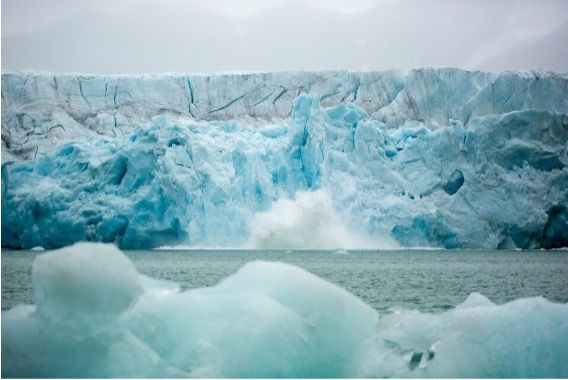
Arctic sea ice has also declined significantly. Since 1979, summer sea ice extent has decreased by 40% to 45%, while the proportion of older, thicker ice has fallen from 60% to below 15%. Ice-free ocean surfaces absorb more solar radiation, accelerating warming. In ocean areas such as the Barents Sea, Kara Sea, Chukchi Sea, and Beaufort Sea, summer sea surface temperatures are now 2–4°C higher than in the past. This heat is transferred back into the atmosphere.
As the Arctic warms, the temperature gradient between the poles and midlatitudes weakens. This reduces the strength of the jet stream and destabilizes its flow. Since 1990, winter minimum temperatures over Northern Hemisphere midlatitude land areas have increased by about 0.4°C per decade. Extreme cold events are generally becoming less frequent, reflecting progressively milder winters. Arctic warming is altering atmospheric circulation, with measurable impacts on midlatitude climates.
Meltwater from Greenland flows into the ocean. Being less saline, it is lighter than surrounding seawater, reducing vertical mixing and weakening ocean circulation. This affects the Atlantic Meridional Overturning Circulation, which has shown signs of weakening by 10%–15% since the mid-20th century. Arctic change does not end with ice loss; it propagates through sea-level rise, ocean circulation, and broader climate systems.
Changes Already Underway—and What Remains
More than 90% of the excess heat accumulated in the Earth system is absorbed by the oceans. Ocean heat content has continued to rise since 2000 and remains at record levels. Once stored, this heat is released slowly over decades to centuries.
Sea-level rise reflects this accumulated heat. Since 1900, global mean sea level has risen by more than 20 cm. The rate of rise has accelerated from 3.3 mm per year since 1993 to about 4.5 mm in recent years. Thermal expansion of seawater and melting land ice both contribute to this increase.
Future changes depend on greenhouse gas emissions. With low emissions, sea-level rise by 2100 may be limited to around 0.3 meters. Under high-emission scenarios, it could rise by more than a meter. While existing heat ensures continued change, future emissions will determine its pace and magnitude.
A Calculated Future Revealed by the Arctic
The Arctic summer is losing its previously uninterrupted whiteness. Sunlight that once reflected off ice now penetrates the dark ocean. The sea quietly accumulates heat. Though invisible, the measurements are unequivocal: Ocean temperatures and heat content continue to reach new records year after year.
Glacier margins retreat by tens of meters annually. Satellites track this movement, and the data point in a consistent direction. Ice is thinning, and melt seasons are lengthening. This is not a seasonal fluctuation. Heat stored in the ocean persists and circulates over decades. Once initiated, this trajectory is not easily reversed. Energy already integrated into the system continues to produce outcomes.
If current trends persist, future coastlines will be drawn in different places. What is considered “average” today will no longer serve as a baseline, and extremes may become the norm.
The Arctic stands at the forefront, revealing these changes. What it shows is not a possibility, but an unfolding reality—one that foreshadows the future of regions yet to arrive at the same threshold.
*Chi-Hyun Park is a longtime Korea-based environmental journalist who holds a PhD in engineering.


My mom tried this game last weekend, and she could not stop laughing every time she crashed into a log. She said it reminded her of watching surfing competitions on TV but way more fun to actually participate. Wave Rider brings joy to people of all ages and backgrounds.
The Arctic is reaching a critical tipping point, and the data is genuinely alarming. Watching the permafrost thaw and ice sheets retreat reminds me that environmental neglect carries long-term consequences. It is much like oral health; if you ignore early warning signs, the damage becomes irreversible. I recently read about this while waiting at my periodontist oakville clinic, and it really put the fragility of our ecosystems into perspective. We must act decisively to curb emissions before these feedback loops accelerate beyond our control. Protecting our planet demands the same level of care and proactive maintenance as our health.
The alarming reality of the Arctic tipping point is hard to ignore. As sea ice vanishes, we aren't just losing a beautiful landscape; we are triggering irreversible chemical and ecological shifts that impact the entire planet. It’s a sobering wake-up call for all of us.
For those planning to witness these fragile ecosystems firsthand, prioritizing safety is essential. If you're heading North, ensure you have comprehensive holiday insurance for seniors to cover any unexpected health or travel disruptions. We must stay informed about these climate changes while taking practical steps to protect ourselves and the environments we visit.
The Arctic is reaching a terrifying tipping point, and it’s sobering to realize how fragile our climate truly is. With sea ice vanishing and nutrient levels plummeting, the entire marine food web is at serious risk. It feels like we are watching a disaster unfold in slow motion.
While planning my future adventures, like exploring the stunning landscapes during new zealand holidays, I’m reminded that these unique environments are connected to global stability. We must prioritize urgent climate action. If we don’t, we’ll lose the natural beauty that makes travel so special. Let’s protect our planet before it’s too late.
This blog post highlights the critical state of the Arctic and its implications for global climate, Escape Road. Have you considered exploring local grassroots initiatives that aim to address these challenges? It would be fascinating to see how community actions could intersect with these broader concerns!