


Life Comes to Earth’s Newest Island
How Birds Colonized Life Forms on Barren Icelandic Lava

In 1963, an unexpected volcanic eruption off the coast of Iceland changed the shape of the world forever: It created the world’s youngest island, Surtsey, named after a giant in Norse mythology.
Scientists immediately grasped the significance of this fledgling island. While lava was still erupting on Surtsey, a group of far-sighted local biologists made landfall. There, the scientists, whose boots were scrubbed clean of possible contaminants, were presented with a unique natural experiment: a virgin land mass, entirely free from human habitation or intentional species introduction, where the assembly of life could be observed and recorded from its creation.

For the next six decades, studies of Surtsey have followed the slow arrival of vascular plants, mosses, and microbes, and then insects and birds. Tracking these activities has offered scientists fundamental insights into how ecosystems appear on bare rock and ash. As Pawel Wasowicz, department director of botany at the Natural Science Institute of Iceland, told The Earth & I: “We have recorded every single colonization event from Year 1. There is no other place on Earth where we have 60 years of uninterrupted human precolonization data.”
“There is no other place on Earth where we have 60 years of uninterrupted human precolonization data.”
Reexamining the Role of Birds
Studies at Surtsey have changed researchers’ understanding of how seeds are dispersed.
As Wasowicz explains: “Our study suggests that animals, and especially birds, play a much bigger role in ecosystem development than we previously assumed.
“The standard view biologists have had since the time of Charles Darwin is that plant arrival could be explained by different seed traits: fluffy seeds carried by the wind, floating seeds carried by water currents, and fleshy fruits dispersed by animals, especially birds, where the seed is expelled after being swallowed.”
“Most textbooks assumed the wind and sea currents were the main long-distance dispersal mechanisms to oceanic islands. Therefore, because Surtsey is 32 kilometers (20 miles) offshore, has strong winds, and is, of course, surrounded by the ocean, the expectation was the wind species would arrive first and dominate, and sea-dispersed species would follow. But our data shows this is the wrong idea,” he says.
Actual evidence points to birds spreading the seeds. Of the 78 plant species that have colonized Surtsey since 1963, documentary evidence reveals 62 have been dispersed by gulls, either by being passed through the animal’s gut or through regurgitation.
This was another surprising discovery for the biologists, as previous assumptions said that a gull’s diet consisted of fish. Instead, when Wasowicz and his team examined bird feces, they found small, dry grass seeds.
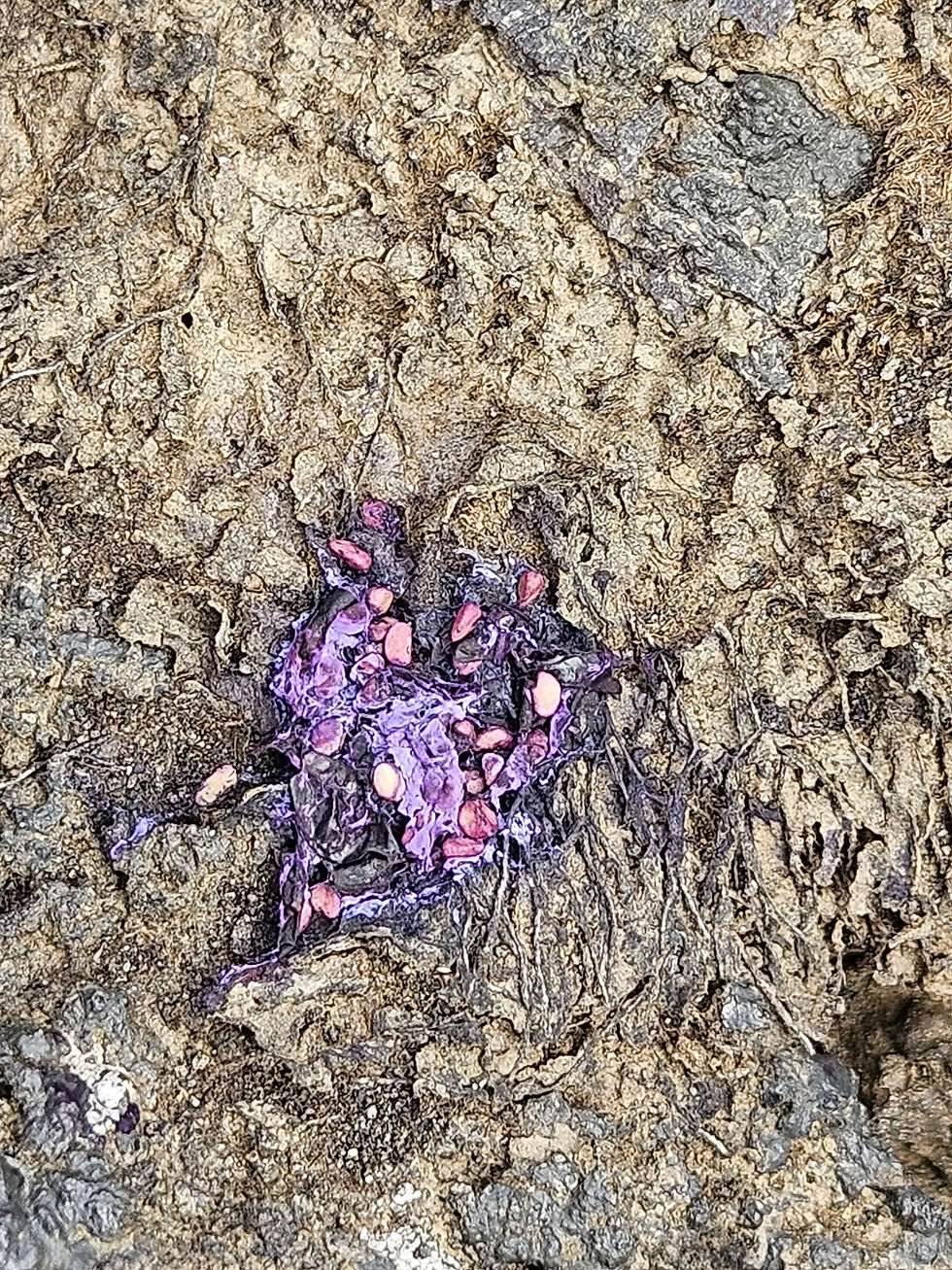
“The most astonishing thing was finding the huge amount of seed inside the gull. You don’t often see gulls eating grass; perhaps we haven’t been paying enough attention!” he says.
Of course, seed alone isn’t enough; plants will struggle to flourish on hard, inhospitable volcanic landscape. But the birds, or “ecosystem engineers,” as Wasowicz calls them, brought the solution to this problem, too, providing fertile soil.
Turning Lava into Fertile Soil
“Another major role of the bird,” he says, “is that they brought fertilizer."
Although the general public might associate nutrient-rich volcanic soil with fertility, soil in the northern latitudes is lacking in one very crucial component.
“There is only a tiny amount of nitrogen, which is the main building block for life. Without nitrogen, you don’t get protein,” Wasowicz notes. “The droppings of the bird are rich in nitrogen, phosphorus and all types of nutrients crucial to plant life. When the birds came, they enriched the whole ecosystem, and this process allowed the vegetation to flourish.”
“When the birds came, they enriched the whole ecosystem, and this process allowed the vegetation to flourish.”
Via a Zoom call from Iceland, Wasowicz showed two photographs taken 40 years apart. One shows a barren, gray volcanic landscape while the other is a lush, green scene, solely engineered by generations of birds.


“They are changing how the ecosystem works by transporting different things. In this case, the birds transformed Surtsey’s soil chemistry and this enabled more complex plant communities to develop,” the botanist says.
New Species Are Arriving
And in this constantly evolving landscape, the Atlantic puffin is set to move into the sites the gulls are currently colonizing.
Wasowicz has spotted the initial signs that the landscape created by other birds will soon become an ideal and welcoming habitat to puffins, the most photogenic of birds.
While 60% of the world’s population of puffins breed in Iceland, numbers have declined there by 70% since 1975, putting the iconic bird on the International Union for Conservation of Nature (IUCN) Red List of Threatened Species.
Wasowicz explains the process where the activities of one bird species will be creating a new landscape for an endangered one: “The gulls came first and started to breed on the island, which enriched the vegetation; we now have this rich, green grassland on the south of the island. And here we slowly saw the first evidence [that] another bird species is coming that relies on the deeper soil—[which is the] puffins. They live in burrows where they dig deep; you cannot dig into lava.”
He adds that although gulls currently breed in the deep grass of Surtsey, this isn’t something they usually do. At some point, they will stop breeding here, and the probability is this will become a breeding and nesting place for puffins, an ideal location where the bird will not encounter ground-based predators.
“The probability is this will become a breeding and nesting place for puffins, an ideal location where the bird will not encounter ground-based predators.”
Another photogenic northern sea creature, the seal, has already arrived, attracted by the seashore habitat created by the gulls. The mammals return in the autumn and winter, bringing with them a lot of nutrients, which also helps pollination. “They were attracted,” Wasowicz says, “by the coastal environment, where they could give birth, and the pups could live in peace for their first few months.”

Global Implications
The great news is that the findings from Surtsey’s outdoor laboratory can be applied elsewhere in the world to support ecological restoration and artificial habitat creation, with birds employed as “ecosystem engineers.”
Wasowicz lists the possibilities: land restoration, wetlands development, mine-degraded land, volcanic sites, and even coastal sites where there is a lack of nutrients transformed into fertile landscapes by the activity of the birds.
“Supporting bird activity,” he adds, “may dramatically speed up these restorations and expand them. You can get seeds and fertilizer into areas that are lacking these components, such as restoring a mining site that has very poor soil. Then you can think about trying to support the bird life of these areas, as this will probably help them.”
This support could come through creating landscapes that are designed to specifically attract birds, such as shallow ponds or small wetlands and heterogeneous habitats that can encourage feeding, cresting, and nesting.
“We need to encourage connectivity where we have corridors and stepping-stones for the animals between the habitats. We can use wildlife and bird life to kick-start transformation. It happened on Surtsey,” Wasowicz concludes.“

*Gordon Cairns is a freelance journalist and teacher of English at the Forest Schools, based in Scotland.


La publicación me resultó interesante por la claridad de la información. La lotería nacional tiene muchos lectores pendientes de sus sorteos, y encontrar datos bien explicados facilita conocer los resultados. También ayuda a mantenerse informado sobre las novedades y a realizar una consulta rápida cuando se necesita algún dato concreto.
Given how remote the island is, every seed that arrives has to travel by wind, sea, or bird. That makes me wonder whether the plant community will keep diversifying as more birds visit, or if the isolation will cap the species list for a long time.
<a href="https://nano-bananapro.com/
">nano-bananapro</a>
I’m wondering if land managers could set up simple perches on eroded slopes to attract birds and let them do the seeding naturally. Sea mayweed getting established here without any planting makes that seem like a low-cost restoration method worth testing.
<a href="https://seedance2-5.org/
">seedance2-5</a>
Watching seabirds drop seeds along the coast near my town reminded me of this. It’s striking how sea mayweed finds a foothold on bare lava, turning a sterile island into a starting point for an entire ecosystem.
<a href="https://nano-banana2.com/
">nano-banana2</a>
Excelente resumen de la participación en la expo y de las mejoras realizadas en la G2 Reverence. Me gustó especialmente el enfoque en la innovación y la experiencia del usuario. Para quienes también buscan información útil, Horario De Las Loterías es un recurso interesante. ¡Mucho éxito en los próximos eventos!